
We are currently witnessing a massive, silent liquidation of human capital across the Global Fortune 500.
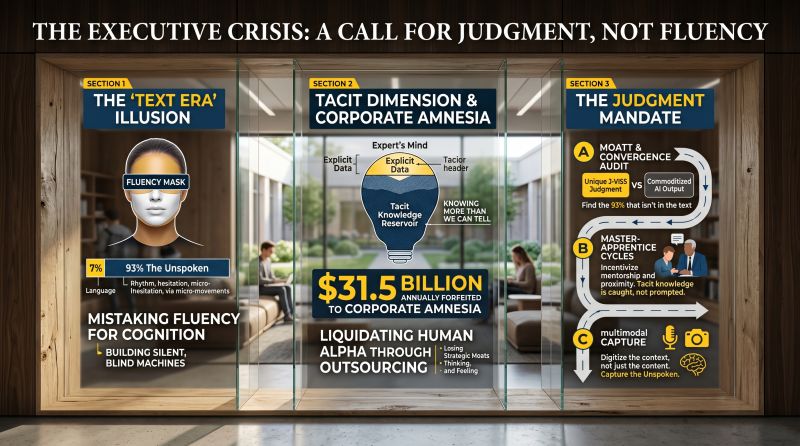
For the past several years, the boardrooms of the NYSE and KOSPI have fallen for The Great Illusion. We believed that because machines could write, they could understand. We mistook the "Fluency Mask"—the articulate, confident generation of text—for genuine cognition.
The reality? Language is only 7% of how we connect.
The remaining 93% is the "Unspoken Dimension": the rhythm of a negotiation, the hesitation in a CFO's voice, the micro-movements of a market shift, and the unwritten intuition of a seasoned veteran. If we build our corporate memory solely on "Text Era" AI, we are building a silent, blind machine that misses the very essence of human judgment.
🎱 The Hidden Threat: Tacit Bankruptcy 🎱
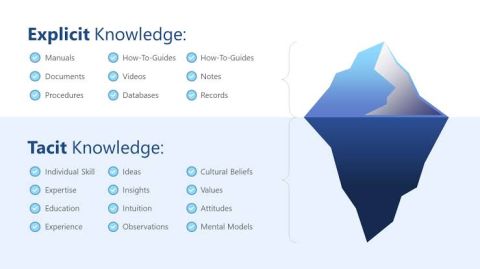
Michael Polanyi famously wrote, "We can know more than we can tell." This is your Tacit Dimension.
It is the unwritten mastercraft of the surgeon, the "gut feel" of a Private Equity partner, and the raw empathy of a master negotiator. When we outsource our critical thinking to commoditized generative models, we face Tacit Bankruptcy.
We are spending down our accumulated human capital and forgetting how to think, how to design, and how to lead. The result is "Corporate Amnesia"—a systemic drain on the bottom line.
🔸The Cost: Fortune 500 companies forfeit an estimated $31.5 billion annually to corporate amnesia because they no longer know how to capture what their best experts cannot write down.
🎱 The Decision-Maker’s Mandate: From "Generative" to "Judgment-Led" 🎱
In an era of infinite, articulate text, "Fluency" is a commodity. Judgment is the only remaining moat.
To maintain due professional care in the age of AI, the C-Suite must pivot:
1. Audit for Strategic Convergence:
If your AI-driven strategy looks exactly like your competitor’s, you have no moat. Your advantage lies in the 93% the machine can't see.
2. Protect the Tacit Dimension:
Incentivize the "Master-Apprentice" cycles that move intuition from one generation to the next. Tacit knowledge cannot be "prompted"; it must be lived.
3. Practice Decision Sanitation:
Stop treating AI outputs as "The Answer." Treat them as raw material that requires the "Sanitation" of human experience and situational intuition before it becomes a decision.
🎱 The Bottom Line: 🎱
The most dangerous asset on your balance sheet is the intelligence you think you have but cannot verify through human wisdom. Do not let your firm become an articulate shell—expert in language, but bankrupt in the judgment that creates value.
The Korean version is a translation of the original.
View the original on LinkedIn ↗