
The traditional 60-month roadmap is an artifact of a linear era. It is an awkward middle ground—too short to capture profound technological paradigm shifts, yet far too long to accurately forecast operational realities.
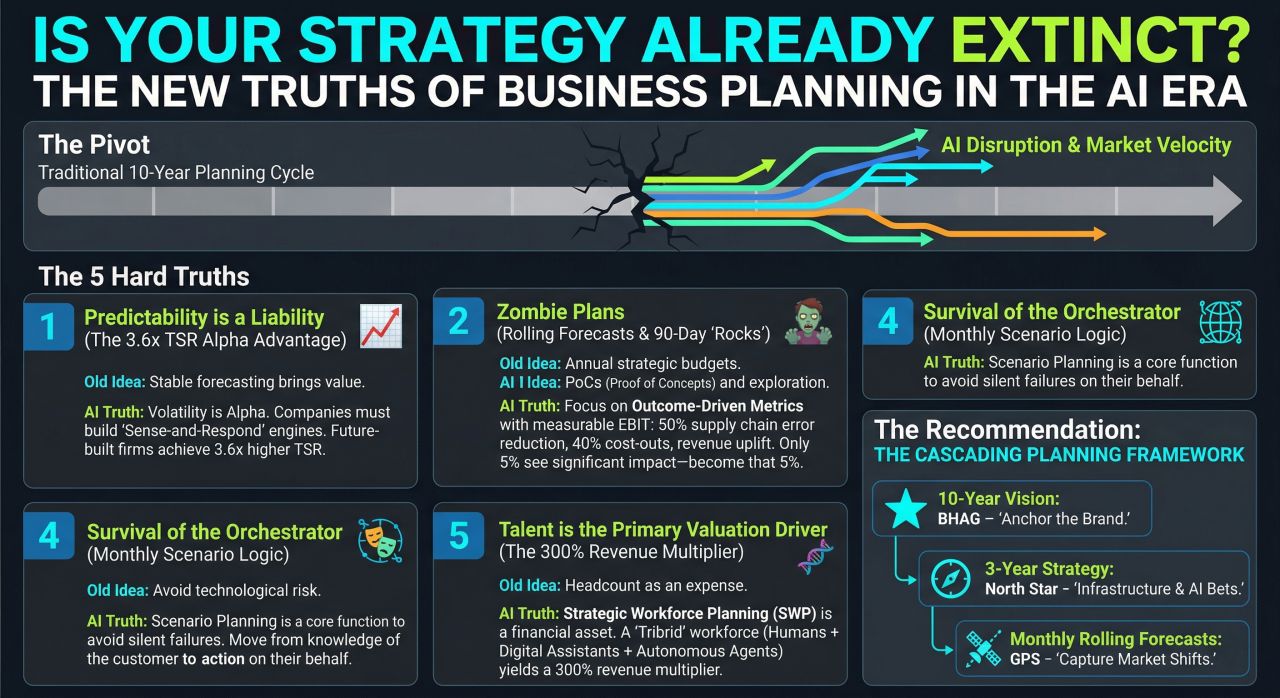
The performance gap is already violently widening. Recent data shows that the 5% of companies truly "future-built" with AI are achieving 1.7x more growth and 3.6x higher Total Shareholder Return than lagging peers.
Their differentiator? They have abandoned static, document-heavy strategy for continuous, adaptive orchestration.
For Boards and Executive Committees aiming to survive and thrive, strategy is no longer a once-a-year documentation exercise. It requires a dynamic, multi-horizon governance framework:
🔭 10-Year Horizon (Vision & Ecosystem): Stop projecting current capabilities. Anchor your organization's ultimate destination, planning the shift from traditional, linear business models to autonomous, AI-driven "Orchestrator" ecosystems.
🏗️ 4-Year Horizon (Architecture & Capital): AI is not a SaaS overlay; it is digital heavy industry. Align your capital allocation with the physical realities of enterprise data architecture and semiconductor production to build a proprietary compute moat.
🗺️ 3-Year Horizon (Zero-Based Org Design): Stop "bolting on" AI for marginal efficiency. Redesign your human capital into a workforce of AI generalists. The fundamental boardroom question must be: If we built this function today, what would the human-machine ratio look like?
🔄 1-Year Horizon (Agile Execution): Discard the static annual budget. Transition to AI-enabled rolling forecasts. Shift capital dynamically based on real-time operational telemetry rather than lagging quarterly financial indicators.
Strategy is now a continuous cognitive capability.
Is your boardroom ready to make AI its strategic co-pilot, or are your current executive compensation metrics still rewarding plans for a world that no longer exists?


The Korean version is a translation of the original.
View the original on LinkedIn ↗