
As leaders, we apply due professional care to our balance sheets, corporate governance structures, and strategic risk management. We analyze decisions with clinical precision. Yet, when it comes to the most complex enterprise we will ever govern—our own lives—we often operate on a fundamentally flawed business model.
Arthur C. Brooks, the Parker Gilbert Montgomery Professor at the Harvard Kennedy School and a Professor of Management Practice at Harvard Business School, exposes this paradox perfectly. In his work The Happiness Files, Brooks brings empirical, peer-reviewed rigor to the "soft" science of well-being, proving that we must actively manage our lives the way a great entrepreneur manages a start-up.
Here is the board-level briefing on why high-achievers often find success so bitter, and how to restructure your personal operating thesis:
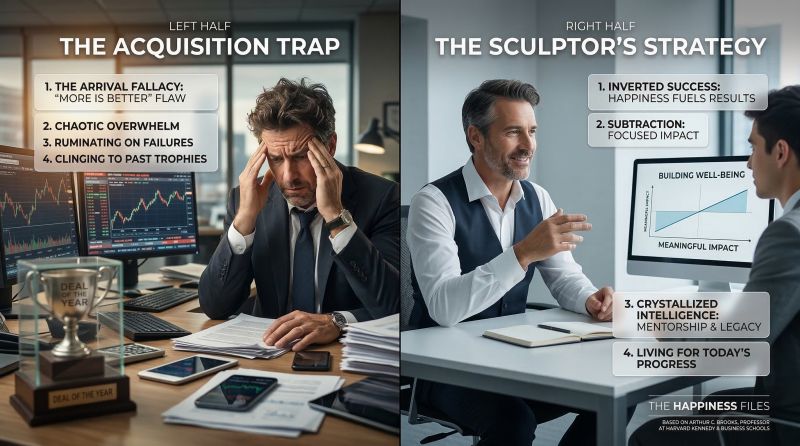
🎱 Invert the Success Equation: In the boardroom, the governing assumption is that driving success will ultimately yield happiness as a dividend. The data dictates a reversal. Working on success to get happier is wildly inefficient; instead, you must build a baseline of well-being first, as happiness is the operational fuel that produces enhanced success.
🎱 Audit Your Failures (Literally): We demand post-mortems for failed M&A deals, but we emotionally ruminate on our personal defeats, which breeds risk avoidance. Brooks advocates for maintaining a written "CV of failures". Documenting setbacks and their specific lessons forces our brains out of emotional panic and into logical, cognitive processing. It transforms raw pain into actionable strategic intelligence.
🎱 Pivot from Addition to Subtraction: Early in our careers, growth is driven by addition—accumulating more titles, more direct reports, and more capital. But as seasoned executives, our strategy must shift to subtraction. We must master the art of chipping away the unessential to focus on our "crystallized intelligence"—the hard-won ability to see complex patterns, explain them, and mentor others.
🎱 Beware the "Ozymandias" Trap: It is tempting to decorate our offices with the tombstones and trophies of past glories. However, preserving these artifacts can trigger "invidious intertemporal autocomparison," forcing us to unfairly judge our present, ordinary circumstances against the ghost of our past peak self. Clear the desk. Govern for today's progress, not yesterday's static victories.
The ultimate metric of a leader is not just the market capitalization of the entity they leave behind, but the quality of the life they constructed along the way.
Are you still endlessly acquiring, or are you ready to start sculpting?
The Korean version is a translation of the original.
View the original on LinkedIn ↗