
The most dangerous AI disruption may be invisible in next quarter’s earnings.🎯📊📉📈
Imagine a private equity firm acquiring a market leader.
The investment case: brand, distribution, loyal customers, recurring revenue. Together, they justify a premium multiple.
Eighteen months later, revenue grows. Retention holds. No warning flashes.
But outside the boardroom, buying behavior is changing.
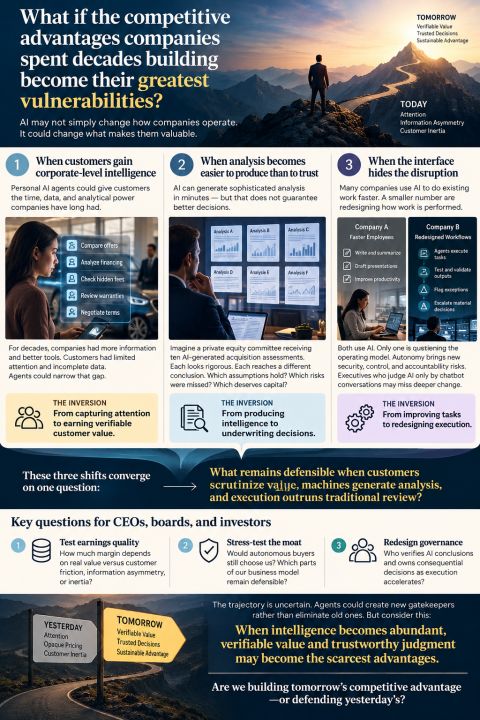
Customers use AI agents to compare total cost, contract terms, alternatives, and actual performance.
The brand still matters. Distribution still matters. But being familiar, prominent, or difficult to compare may no longer confer the same advantage.
‼️The financial statements show yesterday’s moat. The market may already be repricing tomorrow’s.‼️
This is the overlooked AI risk: 🔸moat depreciation before earnings deterioration.🔸
We know how to model depreciation of factories and technology. We are less disciplined about testing whether the economic life of a competitive advantage is shortening.
A business can retain its customers today while losing the mechanisms that made those customers expensive to acquire for competitors.
And there is a second inversion.
Inside the same company, AI produces market research, investment models, and strategic options at unprecedented speed.
Management celebrates output. Yet every polished analysis introduces a harder question: What evidence would prove this conclusion wrong?
When producing answers becomes cheap, 🔸the ability to invalidate bad answers before committing capital becomes valuable.🔸
These two shifts converge at the board table.
One threatens the durability of cash flows.The other threatens the quality of decisions made about those cash flows.
For CEOs, directors, and investors, I would ask three questions:
1. Moat durability : Which part of our margin depends on customer friction rather than superior value?
2. Valuation exposure : What happens to our investment thesis if AI reduces search costs and switching barriers faster than revenue reveals?
3. Decision integrity : Can we independently test AI-generated conclusions before they influence capital allocation?
This is a scenario, not a claim that every market will change the same way. Agents may favor powerful brands or create new gatekeepers.
But that uncertainty is precisely why the thesis deserves stress-testing now.
‼️The next impairment of enterprise value may begin while the investment thesis still looks intact.‼️
Are we measuring what our business earned yesterday—or what will still make it defensible tomorrow?
#CorporateStrategy #PrivateEquity #ArtificialIntelligence #CorporateGovernance
The Korean version is a translation of the original.
View the original on LinkedIn ↗