
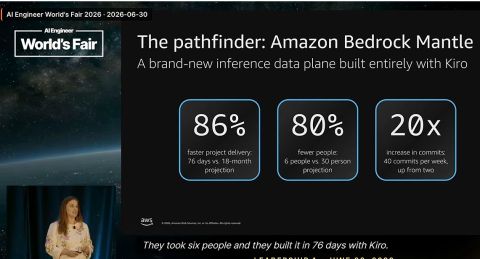
Most treat AI as an incremental 10–20% autocomplete tool. But Amazon’s trials and frontier research reveal a stark divide: some engineers stall at 2–3x gains, while others unlock 10x+ velocity.
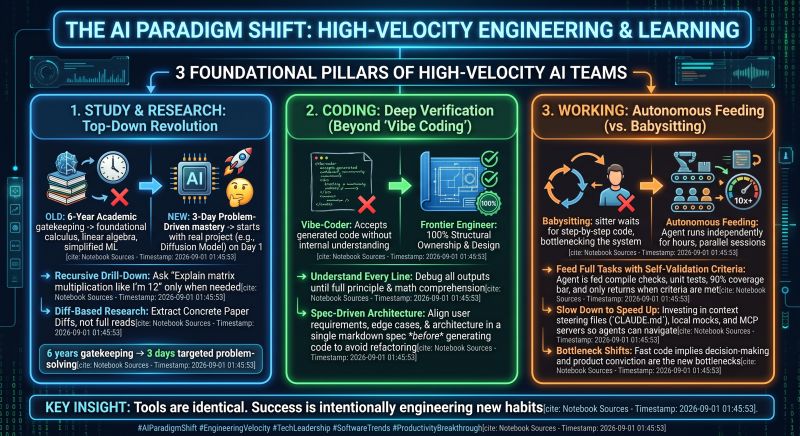
The shift breaks down into 3 pillars:
1. Study & Research: Top-Down Revolution
For decades, higher education forced a rigid bottom-up path. Mastering machine learning meant devoting 4 to 6 years to foundational calculus, linear algebra, and outdated regression models before you were allowed to touch a real production architecture[cite: 3]. Universities held a monopoly on structured foundational knowledge.
That monopoly is over. Mastery has flipped to top-down:
♦️ Start at the Finish Line:
Prompt the AI to build the entire diffusion model project on day one.
♦️ Recursive Drill-Down:
When code breaks or concepts confuse you, query the AI tutor backward: "Why does a ResNet block prevent vanishing gradients?" $\rightarrow$ "Explain matrix multiplication intuition like I’m 12."
♦️ Diff-Based Research:
Instead of reading full academic papers end-to-end, extract the concrete differences (diffs) from prior techniques to evaluate implementation value immediately.
What once required six years of academic gatekeeping can now be internalized in three days of targeted problem-solving
2. Coding: Deep Verification Over "Vibe Coding"
♦️Stop blindly copy-pasting code:
Top builders debug every line until they fully understand the underlying principles and mathematics.
♦️ Spec-Driven Architecture:
Reconciling architecture and edge cases on a single markdown specification document before generating code is exponentially cheaper than refactoring across an entire repository.
3. Working: Autonomous Feeding (vs. Babysitting)
♦️ In a 50-team Amazon pilot, teams that merely sprinkled AI on old habits saw <3x speedups. Teams that overhauled workflows achieved a median 4.5x to 10x+ velocity.
♦️ Feed, Don't Babysit:
Waiting on 30-sec prompt loops makes the human the bottleneck. High-velocity engineers write 1–2% of the code. They feed agents complete task specs with upfront self-validation tests (compilation checks, 90% coverage bars) so agents run independently for hours.
♦️ Slow Down to Speed Up:
Top teams accepted an initial dip in output to lay codebase groundwork—building context files (like CLAUDE.md), mocking external dependencies locally, and creating MCP servers so agents could navigate legacy code.
♦️ The New Bottleneck:
When code creation collapses from 9–12 months to 1–2 months, writing code is no longer the bottleneck—human decision-making, product conviction, and launch approvals are.
Stop babysitting tools. Define the validation criteria, step out of the loop, and let the system run.

The Korean version is a translation of the original.
View the original on LinkedIn ↗