
Meanwhile, Fortune 500 CEOs are asking a much quieter question :
"Why hasn't our P&L actually moved?"
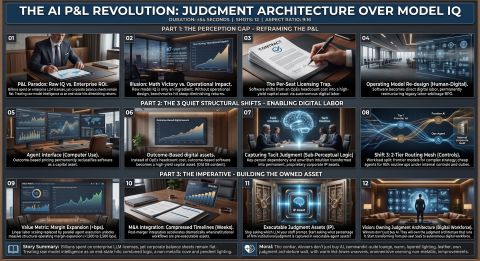
Despite billions spent on enterprise LLM seats, aggregate productivity hasn't exploded. Corporate balance sheets look virtually identical to three years ago.
Many on Wall Street suspect an AI bubble. They are looking in the wrong place.
The mistake isn't AI. The mistake is treating raw cognitive intelligence as an end in itself. In business, raw model IQ hits steep diminishing returns without operational architecture.
The real transformation isn't happening in foundation model benchmarks.
It is happening in 3 quiet structural shifts redefining the modern enterprise :
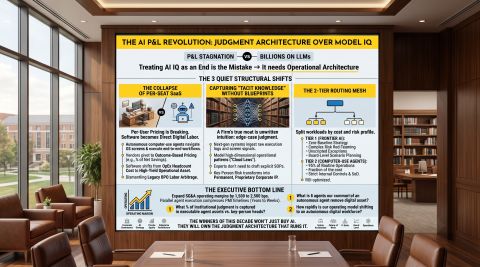
1️⃣ The Collapse of Per-Seat SaaS
Per-user, per-month SaaS pricing is breaking. When autonomous computer-use agents navigate OS screens and execute end-to-end workflows, software becomes direct digital labor.
The Shift: Vendors pivoting to outcome-based pricing (e.g., taking a percentage of net savings) reclassify software from an OpEx headcount enablement cost into a high-yield operational asset—permanently dismantling legacy BPO labor arbitrage.
2️⃣ Capturing "Tacit Knowledge" Without Blueprints
Michael Polanyi famously noted: "We know more than we can tell."
A firm’s true competitive moat lives in unwritten intuition—the edge-case judgment of senior underwriters, trade compliance officers, and master operators.
The Shift: Instead of forcing experts to draft explicit SOPs, next-gen systems ingest raw execution logs and screen signals to model high-dimensional operational patterns ("Cloud Laws"). Key-person risk is transformed into permanent, proprietary corporate IP.
3️⃣ The 2-Tier Routing Mesh
Deploying $20/token frontier API models for routine tasks is an ROI disaster. Winning enterprise architectures split workloads by cost and risk profile:
Tier 1 (Frontier AI): Zero-baseline strategy, complex risk red-teaming, unscripted edge cases, and board-level scenario planning.
Tier 2 (Computer-Use Agents): 95% of routine operations executed at a fraction of the cost under strict internal controls and Segregation of Duties(SoD).
🎱 The Executive Bottom Line
In SG&A and process-intensive operations, replacing linear labor scaling with parallel agent execution can expand functional operating margins by 1,500 to 2,500 basis points while compressing Post-Merger Integration (PMI) timelines from years to weeks.
Stop asking which LLM your teams are prompting on their laptops.
Start asking your executive committee:
🔸 What percentage of our firm’s institutional judgment is captured in executable agent assets versus key-person heads?
🔸 How rapidly is our operating model shifting from per-seat software to an autonomous digital workforce?
The winners of this decade won't just buy AI. They will own the judgment architecture that runs it.
The Korean version is a translation of the original.
View the original on LinkedIn ↗