
Here is why underwriting it as pure automation will destroy capital. 🚨
There is a dangerous valuation trap taking over private equity and venture capital right now:
The belief that autonomous AI agents can run end-to-end enterprises, eliminate human headcount, and drive operating margins toward 100%.
While it looks irresistible on a spreadsheet, it collides directly with an inescapable law of organizational economics:
👉 Distributed Tacit Knowledge.
Here is how the collision between agentic AI and human tacit knowledge is quietly rewriting AI Investment, Valuation, M&A Strategy, and Operational Excellence:
1️⃣ Code Is Commodity. Tacit Is the Moat.
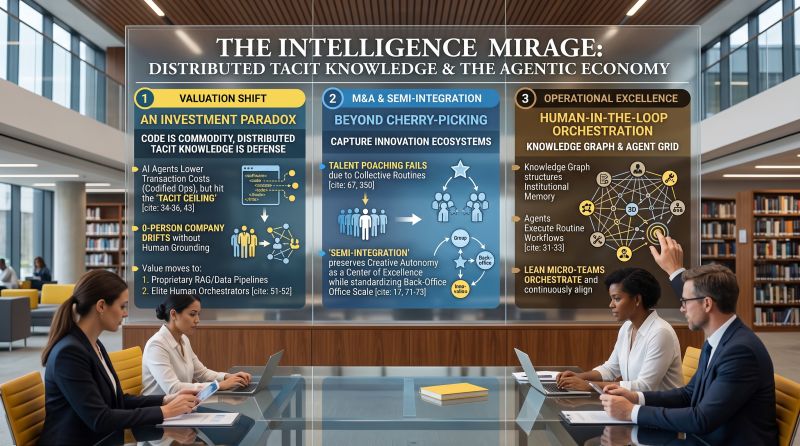
If AI generates standard code in seconds, it can generate the exact same code for your competitor. Commodity execution is not an economic moat. Terminal value isn't in standard software—it lives in proprietary data networks and the elite human orchestrators steering the system.
2️⃣ The Tacit Knowledge Ceiling
AI agent swarms lower transaction costs to near zero for structured, deterministic tasks (accounting, compliance, code deployment). But purely autonomous setups decay over time. Without human context, ungrounded AI suffers from operational drift and strategic hallucinations. Strategic judgment, real-time negotiation feel, and edge-case innovation still require human wisdom.
3️⃣ You Can't "Cherry-Pick" Talent in M&A
Traditional tech M&A tried to buy innovation by licensing patents or "acqui-hiring" star engineers. In an agentic economy, this fails. Innovation lives in distributed team routines, shared culture, and institutional memory. Stripping a star engineer away from their collective team destroys the very ecosystem that created their output. Acquirers must buy the whole living ecosystem.
4️⃣ The Winning M&A Playbook: "Semi-Integration"
Don't crush acquired innovators under legacy corporate bureaucracy. Dealmakers must bifurcate post-merger integration:
🔸 Centralize Scale: Standardize back-office reporting, legal, compliance, and global distribution.
🔸 Protect Autonomy: Keep the acquired creative R&D core autonomous as a standalone "Center of Excellence" to preserve its tacit operating culture.
5️⃣ Redefining Operational Excellence (OpEx)
Achieving OpEx transitions from static SOPs to Human-in-the-Loop Orchestration:
🔸 Knowledge Graphs & Institutional Memory: Structure corporate memory and map business logic, grounding AI agent networks so they execute without drifting.
🔸 Lean Micro-Teams: Hyper-lean units of generalists direct domain agents, cutting due diligence and PMI lead times from months to days.
💡 The Executive Takeaway: The winning enterprise isn't a 0-person company. It is a hyper-lean unit of human generalists orchestrating vast networks of specialized AI agents.
T
The Korean version is a translation of the original.
View the original on LinkedIn ↗