
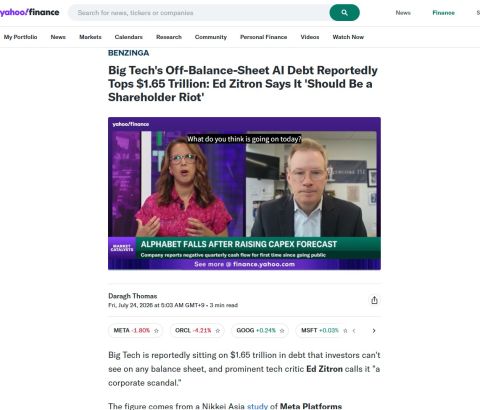
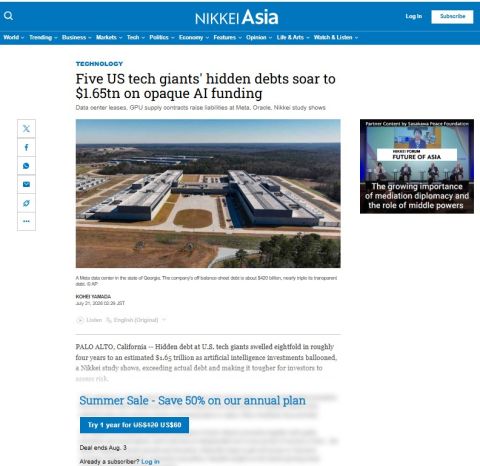
In corporate finance, what you see on the front page of a balance sheet is rarely the whole story. While executives and investors often focus on formal debt ratios, a silent risk is quietly scaling across global markets. Recent investigative insights into five major U.S. tech giants reveal a staggering $1.65 trillion in off-balance-sheet commitments tied to the artificial intelligence infrastructure boom. It serves as a masterclass in a timeless governance hazard: the dangerous gap between legal accounting compliance and underlying economic reality.
What Is an Off-Balance-Sheet (OBS) Item?
🔸 On-Balance-Sheet Debt: Taking a direct loan and writing it in bold letters on the front page of your ledger for immediate visibility.
🔸 Off-Balance-Sheet Commitments: The modern financial equivalent of securing multi-billion-dollar data center capacity through long-term rental and purchase agreements without borrowing cash upfront.
🔸 The Accounting Mechanism: Following strict US GAAP or IFRS rules, these obligations bypass primary debt lines and are tucked away in fine-print footnotes.
🔸 The Underlying Danger: While fully legal, these multi-year contracts behave economically exactly like senior debt, requiring mandatory cash outflows regardless of whether business is booming or hitting a wall.
The Big Tech Case Study: A $1.65 Trillion Reality Check
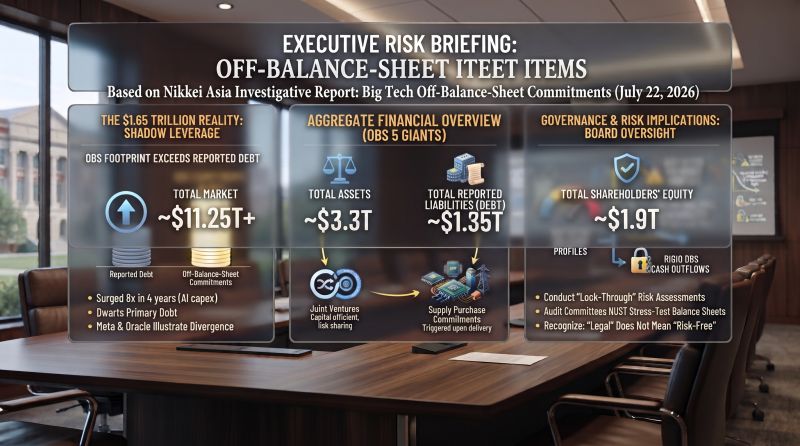
🔸 The Scale: Combined off-balance-sheet commitments for Alphabet, Amazon, Meta, Microsoft, and Oracle have surged to $1.65 trillion, eclipsing their formal on-balance-sheet debt of $1.35 trillion.
🔸 The Cumulative Burden: Total cumulative liabilities of ~$3.0 trillion (combining $1.35 trillion in on-book debt and $1.65 trillion in off-book commitments) rival their entire on-book physical asset base of ~$3.3 trillion, backed by ~$1.9 trillion in on-book shareholders' equity.
🔸 The Market Illusion: A total combined market capitalization exceeding $11.25 trillion can induce false security. Heavy off-book obligations leave a narrow margin of error if monetization timelines slip.
Key Implications for Boards
1. Beware Single-Metric Blindness: Traditional ratios paint a deceptively conservative solvency picture.
2. Stress-Test Downsides: Model plateaus that turn fixed contracts into heavy financial anchors.
3. Redefine Due Professional Care: Fiduciary duty demands look-through analysis of unrecorded cash velocity.
The Korean version is a translation of the original.
View the original on LinkedIn ↗