
The recent New York Times Magazine roundtable laid bare a structural shift that most corporate leaders are still missing. We are moving past the era of the passive "AI chatbot" and entering the era of the Hybrid Human-AI Workforce.
https://lnkd.in/gwW5Vdg8
When execution costs drop to near zero, where does your value go?
It moves upstream.
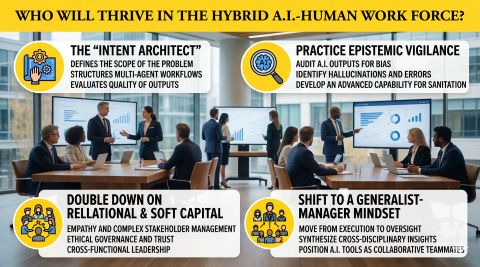
The future belongs to the "Intent Architects"—professionals who treat AI not as a software tool, but as an active, collaborative team.
If you want to thrive in this reset, you need to shift from a focus on execution to a focus on governance. Here is the three-part framework to position your career ahead of the curve:
1. Shift from Task Completion to Intent Architecture
🔸 The Old Way: Writing the report, running the analysis, or coding the script.
🔸 The New Way: Defining the scope, structuring multi-agent workflows, and connecting disparate business functions. Generalist agility and cross-disciplinary synthesis are the new premium skills.
2. Practice Epistemic Vigilance (Output Sanitation)
As organizations deploy fully autonomous agentic workflows, the biggest risk is no longer speed—it’s quality. The human-in-the-loop must act as a rigorous developmental editor. Your value lies in your ability to audit AI outputs for structural bias, hallucination, and strategic alignment.
3. Double Down on Relational Capital
AI cannot build trust, navigate complex stakeholder politics, or provide ethical governance. The more technical execution becomes democratized, the more valuable deep empathy, cross-functional collaboration, and high-stakes decision-making become.
🎱 The Bottom Line:
Stop competing with AI on processing speed or data volume. Lead it strategically. Turn your technical expertise into managerial oversight, and treat your AI tools the way a senior executive manages an analytical team.
How is your organization adapting its workflow to this hybrid model?
The Korean version is a translation of the original.
View the original on LinkedIn ↗