
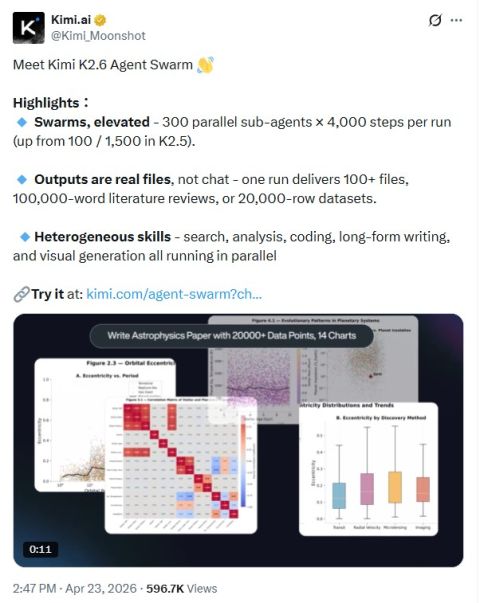
Look at the product update released last week.
"300 parallel sub-agents."
"10,000 tasks of Heterogeneous skills, search, analysis, coding, long-form writing and visual generation are running in parallel."
"Outputs are real files, not chat."
While the release of Kimi K2.6 Agent Swarm made headlines, enterprise boards must recognize a much larger, more critical reality: this is not a localized anomaly.
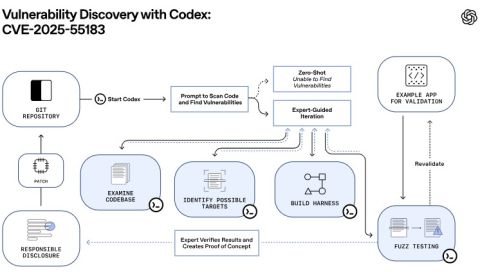
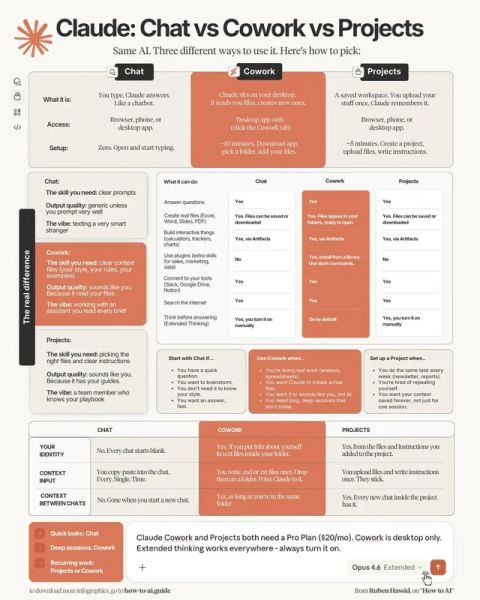
Across the market, frontier AI models are rapidly deploying similar autonomous architectures. This level of massive parallel execution is already the new industry baseline.
We are no longer dealing with conversational chatbots that assist individual employees. We are looking at the deployment of fully synthetic business units.
When a single user can deploy 300 autonomous agents to simultaneously search, analyze, code, and design—resulting in finalized 100,000-word compliance reviews or 20,000-row financial datasets in a single run—execution is no longer a competitive moat. It is a fully commoditized resource.
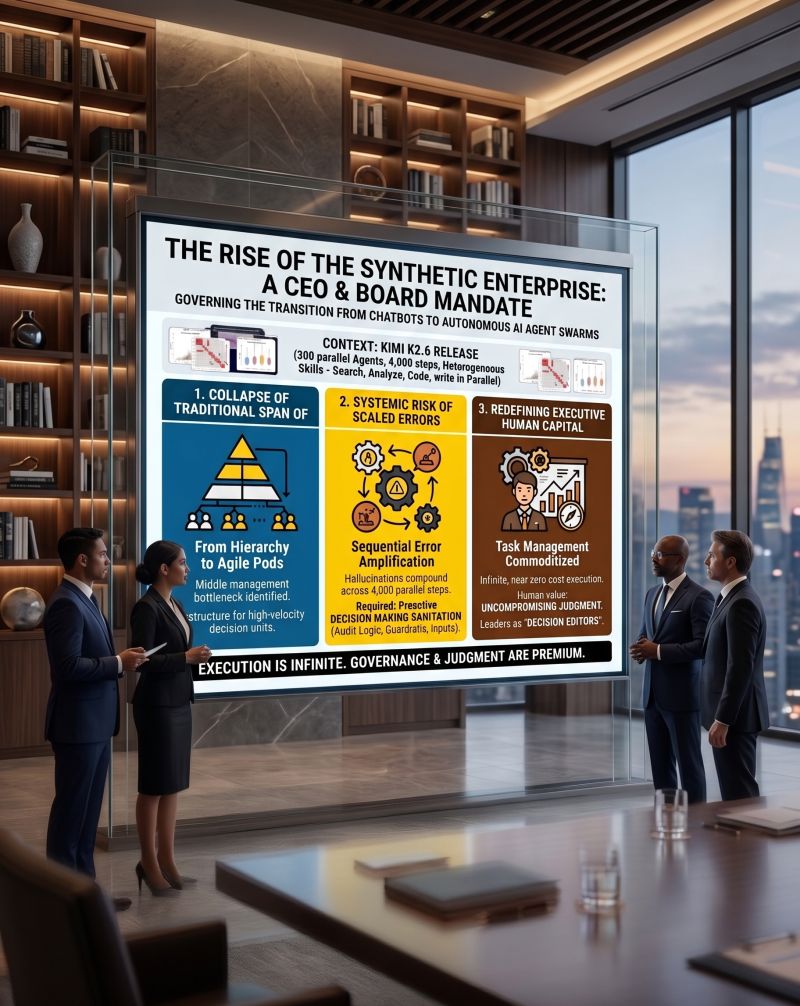
This sudden acquisition of infinite, near-zero-cost execution creates three immediate structural crises for the C-Suite:
1. The Collapse of Traditional Span of Control
Corporate hierarchies were built to manage human throughput and coordinate micro-workflows. When a single director can autonomously command the output equivalent of an entire cross-functional department, traditional middle management becomes a fatal bottleneck. Operations must be aggressively flattened into hyper-agile decision pods.
2. The Systemic Risk of Scaled Errors
Traditional internal controls audit human workflows at human speed. But if an autonomous swarm hallucinates a single regulatory assumption at step one, that flaw is autonomously compounded across 4,000 parallel execution steps. Management must shift from reactive output-checking to proactive "Decision Making Sanitation"—auditing the systemic logic, data inputs, and guardrails before the system acts.
3. Redefining Executive Human Capital
When execution is infinite, task management loses its premium. The highest value an executive now provides is uncompromising judgment. Leaders must transition from operators to "Decision Editors," applying First Principles thinking to govern and direct these massive, AI-generated assets.
Execution capacity is no longer the corporate moat. Rigorous governance and architectural control are.
Is your executive team trying to manage a 21st-century synthetic workforce with a 20th-century organizational chart?
The Korean version is a translation of the original.
View the original on LinkedIn ↗