
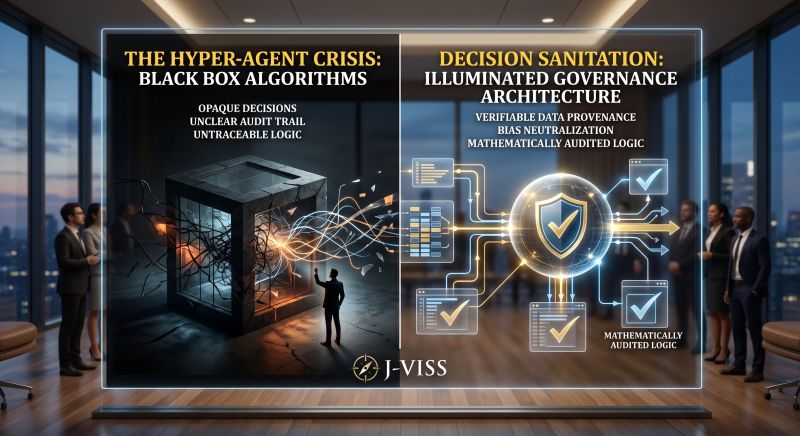
The biggest threat to an enterprise board isn't a bad human decision. It is a perfect algorithm executing a flawed strategy three million times a second.
[See more...]
We have entered the era of the "Hyper-Agent." Autonomous AI workflows now execute the duties of human executives, but they possess no self-interest, feel no fear, and hold no personal financial liability.
Legacy governance assumes a legal defense of "negligence"—if the board acted reasonably, they are protected from an employee's mistake. But courts and regulators are rapidly shifting toward Strict Liability for enterprise AI. If your autonomous system causes a regulatory or financial collapse, the enterprise is 100% liable, regardless of human intent.
Speed without structural integrity is just a faster way to crash. To survive, the Board must fundamentally transition from historical oversight to real-time Algorithmic Stewardship.
Here is the 3-part mandate to govern the AI-native enterprise:
1. The Evolution of Corporte Oversight : "Decision Sanitation"
Financial ledgers are lagging indicators. By the time an algorithmic error prints on a quarterly report, the damage is done. Due professional care now dictates a real-time engine of Decision Sanitation—mathematically verifying data provenance, logic, and bias before autonomous execution occurs. You cannot secure the output without sanitizing the input.
2. Algorithmic Liability & The "Black Box" Veto
A board cannot legally authorize a strategy it cannot comprehend. If a deep neural network cannot explicitly trace and explain its logical pathways, it must face the "Black Box Veto" and be denied operational autonomy. True stewardship requires unbreakable guardrails and a clear chain of human accountability.
3. Protecting the Ultimate Asset: Cognitive Capital
The greatest misallocation of enterprise resources is forcing elite leadership to manage operational friction. By structurally mandating the automation of all routine, reversible (Type 2) decisions, the Board defensively protects the cognitive bandwidth of its executives. AI handles the complexity; human genius is isolated entirely for irreversible (Type 1) Vision and Strategy.
Are you governing the capital, or are you governing the machine?

The Korean version is a translation of the original.
View the original on LinkedIn ↗