
If you sit on the Board or C-suite of a Global firm, the current market hype is masking a severe structural risk. The rational, no-nonsense reality of the 2026 AI landscape reveals glaring blind spots where executives are sacrificing long-term moats for short-term illusions.
Here are the three paradoxes quietly destroying corporate value:
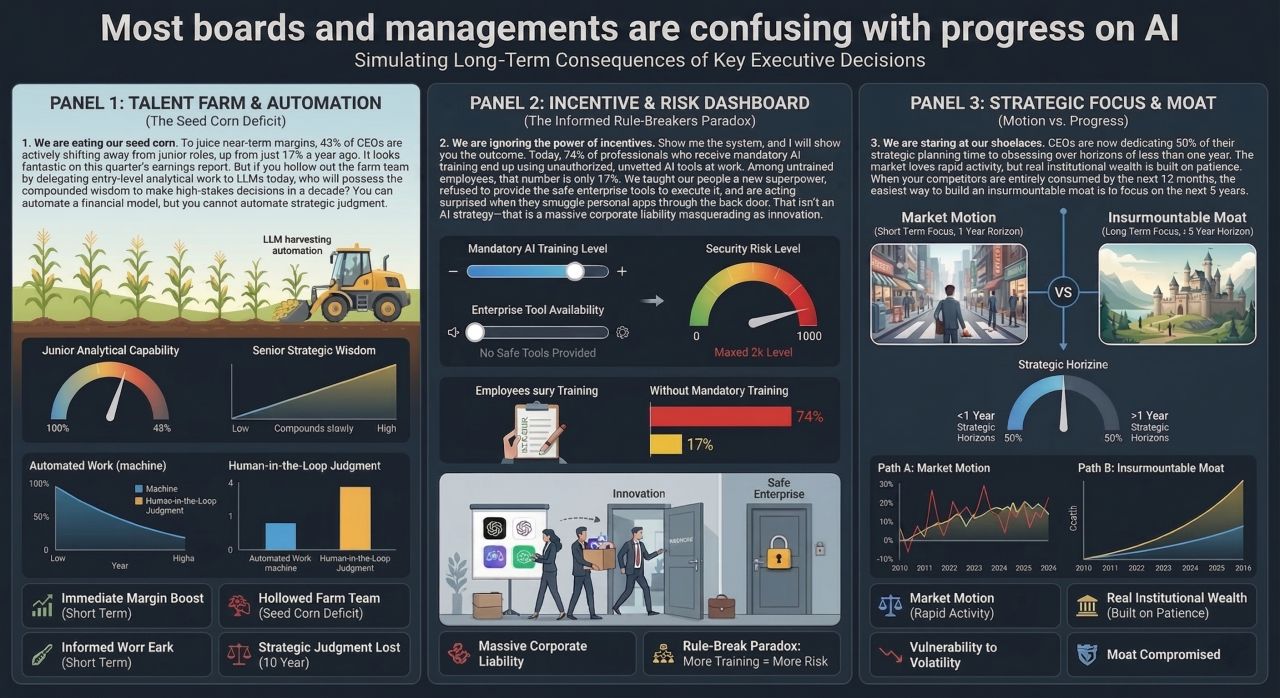
1. We are eating our seed corn. To juice near-term margins, 43% of CEOs are actively slashing junior roles, up from just 17% a year ago. It looks fantastic on this quarter’s earnings report. But if you hollow out the farm team by delegating entry-level analytical work to LLMs today, who will possess the compounded wisdom to make high-stakes decisions in a decade? You can automate a financial model, but you cannot automate strategic judgment.
2. We are ignoring the power of incentives. Show me the system, and I will show you the outcome. Today, 74% of professionals who receive mandatory AI training end up using unauthorized, unvetted AI tools at work. Among untrained employees, that number is only 17%. We taught our people a new superpower, refused to provide the safe enterprise tools to execute it, and are acting surprised when they smuggle personal apps through the back door. That isn't an AI strategy—that is a massive corporate liability masquerading as innovation.
3. We are staring at our shoelaces. CEOs are now dedicating 50% of their strategic planning time to obsessing over horizons of less than one year. The market loves rapid activity, but real institutional wealth is built on patience. When your competitors are entirely consumed by the next 12 months, the easiest way to build an insurmountable moat is simply to look five years out.
The Bottom Line:
As AI commoditizes rapid execution, the ultimate corporate premium shifts entirely to JaaS, the ability to apply due professional care and validate high-stakes outputs before they influence capital allocation.
Surviving this divergence requires moving away from fragmented tactics and adopting a rigorous J-VISS framework — perfectly aligning your Vision, Information, System, and Strategy. True AI advantage is about aggressively compounding the human judgment that machines still cannot replicate.
In a market moving at hyperspeed, the ultimate competitive advantage isn't being the fastest. It is a long attention span.

The Korean version is a translation of the original.
View the original on LinkedIn ↗