
The C-suite graveyard is littered with brilliant strategies that failed for one simple reason: they lacked the balance between Sense and Sensibility.
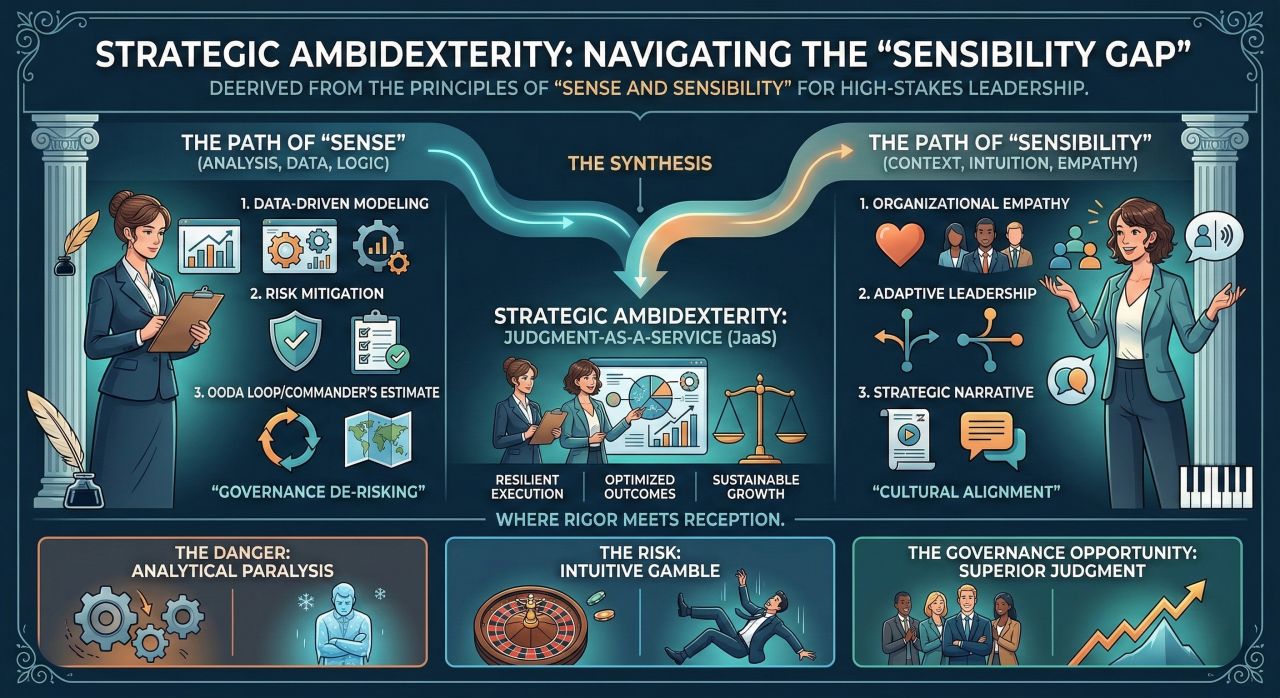
We live in an era obsessed with "Sense"—the cold, hard metrics, the predictive modeling, and the data-driven rigor that promises to optimize every variable. It is a necessary foundation. But the most effective leaders recognize that a perfectly modeled strategy can still collapse if it ignores the "Sensibility"—the human context, cultural inertia, and the invisible power dynamics of an organization.
The Analytical Trap
Reliance on "Sense" alone turns a company into a spreadsheet. It provides a map, but it fails to account for the terrain of human emotion and institutional habit. You can calculate the precise ROI of a digital transformation, but if you ignore the "Sensibility" of your workforce’s transition, your strategy will evaporate in the face of resistance.
The Intuitive Gamble
Conversely, relying purely on "Sensibility"—the seasoned executive’s gut feeling—is a gamble. It is often non-reproducible and fails to provide the board with the defensible governance required to de-risk high-stakes decisions.
The Competitive Advantage: Strategic Ambidexterity
True leadership, particularly at the board and executive level, requires Strategic Ambidexterity:
🟠 Sense is your compass: It is the rigorous analytical framework—the OODA Loop, the decision trees, and the objective reality. It ensures your trajectory is sound.
🟠 Sensibility is your navigation: It is the nuanced intelligence of how that trajectory intersects with human behavior. It ensures your execution is adopted, not just dictated.
Judgment-as-a-Service (JaaS)
In an age of autonomous agents and rapid AI disruption, the ability to synthesize these two is your most valuable asset. It is what separates those who simply process data from those who provide Judgment-as-a-Service (JaaS).
When you sit at the table, don't just present the numbers. Present the context behind them. Don't just demand compliance; engineer alignment.
The highest form of business strategy is not just knowing what to do, but understanding how it will be felt and received by the organization.
Are you building a company, or are you building a machine? The difference is where your judgment lives.


The Korean version is a translation of the original.
View the original on LinkedIn ↗